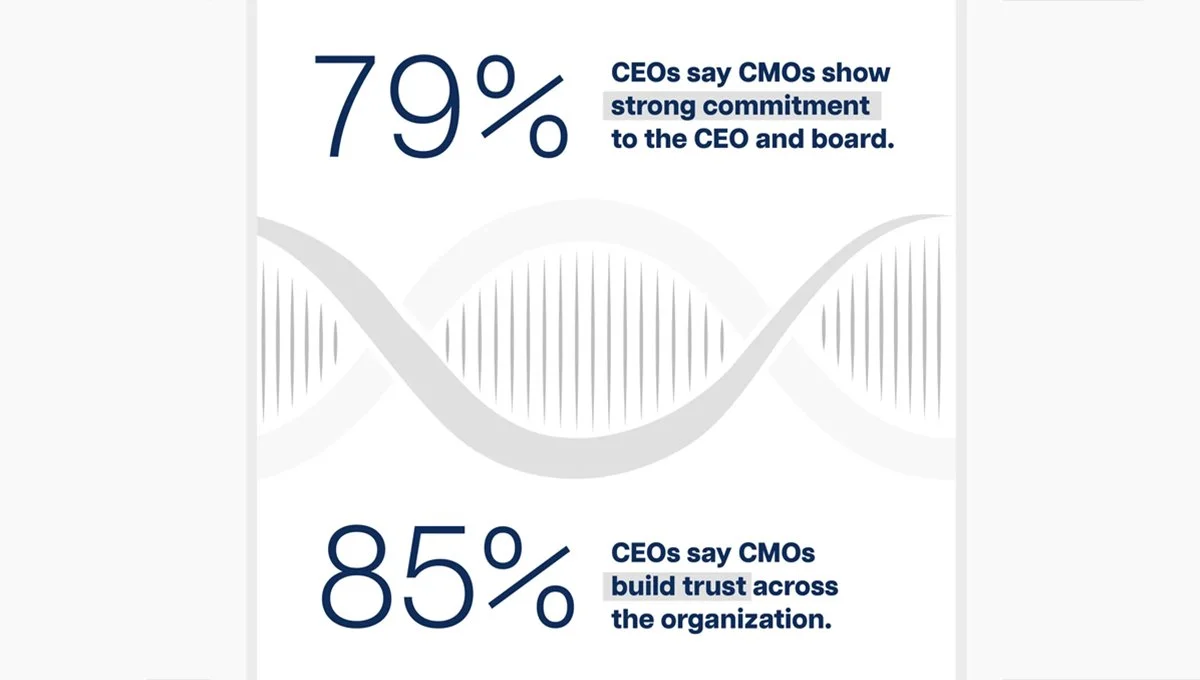
CMOs continue their uphill climb in the eyes of their CEOs: Boathouse study

ORIGINALLY PUBLISHED In Digiday
By: Michael Bürgi

If you’re doing well in the eyes of your boss, chances are you’re going to keep your job for at least a little while. But if the goalposts of “doing well” change year after year, it’s hard to feel comfortable about anything.
Such is the case with CMOs, whose performance and contribution to a company’s greater good has evolved rapidly over the years, notably since the pandemic changed so many elements of marketing.
According to a study by independent full-service agency Boathouse, CMOs have worked hard to align their mission more closely with what CEOs need from them, but they’re also seen generally as a contributor to a company’s success rather than a primary driver. Digiday was given a chance to see the study before its public release later today.
It’s the fifth edition of the study, which elicited input from 150 CEOs about their CMOs from a wide swath of industries (healthcare, tech, finance, CPG, retail and others) — and it uncovers a bit of a paradox in the boss’s thinking. Where 68% of CMOs are seen as actively contributing to strategy and strategic decisions, only 8% are perceived as actually leading it.
“From where we started five years ago, the CMO has cleaned up the relationship variables considerably,” said John Connors, founder and CEO of Boathouse. “It’s really positive to see because they were failing that relationship test for so many years. So they’ve strengthened the relationship test, but weakened on performance and execution variables.”
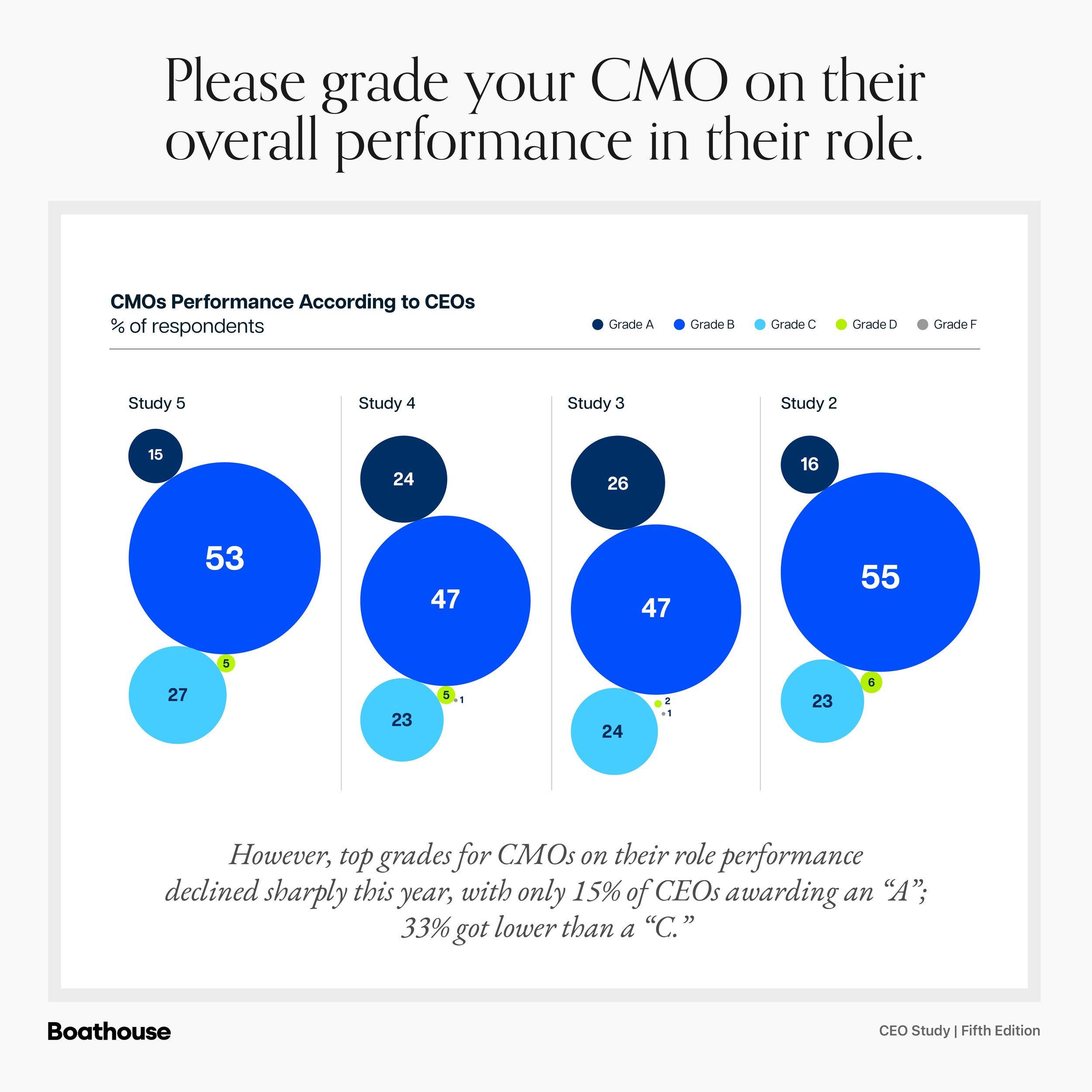
To wit, this fifth installment of the study asked CEOs to grade their CMOs’ performance, and tellingly the percent receiving an A grade dropped from 24% to 15% — the good news being that those receiving a B grade rose from 47% the prior two years to 53%, which is still just over half.
Fragmentation of duties brought on by fragmentation of the industry only compounds the challenges that CMOs face — and some of it echoes Deloitte’s CMO study, which was released March 31. (Deloitte’s by contrast speaks to CMOs themselves rather than the CEO.)
“There are now like [thousands of] different martech solutions, and yet no one’s getting ROI from martech,” noted Connors. “Now you add AI fragmentation on top of data fragmentation, and their orgs are siloed. Other than that, it’s rosy.”
AI fragmentation is real, acknowledged by both studies. As Deloitte pointed out in its study, AI will account for more than half of all marketing activities by end of 2028 “The business case is strengthening: measurable improvements in sales productivity, customer satisfaction and marketing overhead costs have all risen year over year,” read a blog announcing the Deloitte study.
On the other hand, read the blog, “No marketing technology activity scores above 5 on a 7-point performance scale. This includes key steps such as ‘integrating marketing technologies into our customer funnel’ and ‘generating ROI from marketing technologies’.”
CMOs “are trying to buy time by spending more budget on more short-term variables,” added Connors. “CEOs are seeing that lack, that gap, so you have this real performance confidence problem that’s emerging.”
Does this end up giving agencies the chance to help solve these challenges? Maybe, but what it does point to in Connors’ mind is a lean toward specialization.
“The trick is, we’re really wrestling with specialization vs. generalization,” he explained, with an eye toward specialization. “Agencies structurally have had one of everything. But that math is so different for each company in each industry that it’s forcing function to specialization. The data for a consumer packaged goods [client] versus a hospital system, vs. an insurance company vs. a wealth management firm, is so different. And if you can’t walk in with a benchmark, you’re in a weak spot.”
More Insights