CEO confidence in their CMOs is on the decline
ORIGINALLY PUBLISHED In The Drum
By: Jennifer Faull
The annual survey of CEOs on the CMO role showed lower performance ratings and more leaders viewing the marketing function as a cost center.

Chief executives’ confidence in their chief marketing officers is weakening as more CEOs question marketing’s strategic impact, leadership capability and commercial value, according to new research from Boathouse.
The agency’s fifth annual survey of chief executives on the marketing function and the CMO’s role is based on interviews with 150 CEOs from top US companies. A third of the CEOs interviewed represented companies with reported revenue of between $250m and $500m, a third with $500m to $1bn and a third with revenue over $1bn. Nearly two-thirds (61%) ran organizations with over 1,000 employees.
The findings suggest that while marketing remains an important growth function, confidence in its leadership is softening.
Only 15% of CMOs received an ‘A’ rating from their CEOs in this year’s study, while almost a third (32%) were rated ‘C’ or lower. Compare this with last year’s study, where 24% were given the top grade and just 29% were rated ‘C’ or lower. More than half of CMOs (53%) are now seen as ‘average,’ pointing to a widening gap between the perceived importance of marketing and the performance of those leading it.
The findings suggest CEOs are not yet convinced that CMOs are operating as strategic growth leaders. Four in 10 CMOs were rated ‘C’ or below in their ability to drive strategy and growth, while 57% of CEOs said they primarily view their CMO as an execution leader, compared with 43% who see them as a strategic adviser.
“One of the things we’ve been pushing since we started this survey five years ago is that CMOs have to do a better job building CEO relationships,” says John Connors, founder and CEO of Boathouse.
“The signals are that they’re doing a much better job of relationship building, but strangely, the contradiction is that, at the same time, they’re losing credibility on execution and delivering growth. CMOs need to start thinking a little bit less about protecting their own rear ends and focus more on actually driving the company’s growth.”
That distinction appears to be shaping the nature of the CEO-CMO relationship. Boathouse found that discussions between CEOs and CMOs are increasingly focused on metrics and performance, with less emphasis on wider business strategy. The result is a role still closely associated with delivery, measurement and short-term results rather than long-term direction.
The decline is also evident in CEOs’ assessments of core leadership skills. Ratings for problem-solving fell from 57% to 49%, while perspective-seeking and long-term vision were rated at 43% and 47%, respectively. Overall confidence in the CMO role now stands at 43%.
The pressure on CMOs is rising as the function’s remit expands. Boathouse found that CMOs are being held four times more accountable for return on investment from artificial intelligence than any other executive. Yet nearly half of CEOs (46%) rated their CMOs’ AI capability as ‘C’ or lower.
AI is becoming a particularly sharp test of marketing leadership. More than half of CEOs (54%) expect AI to deliver both growth and efficiency, while most expect to see a measurable impact within six to 12 months. However, current adoption remains concentrated in more executional areas such as analytics, customer experience and content, at 69%, 67% and 63%, respectively. Use of AI in strategy is much lower, at 36%.
Despite the more critical view of CMOs, growth remains marketing’s central mandate. Almost two-thirds of CEOs (65%) cited sales growth as marketing’s top priority, followed by improving brand reputation. The research also points to a rising focus on brand narrative, with the proportion of CEOs citing the need to transform the company narrative doubling year over year from 23% to 47%.
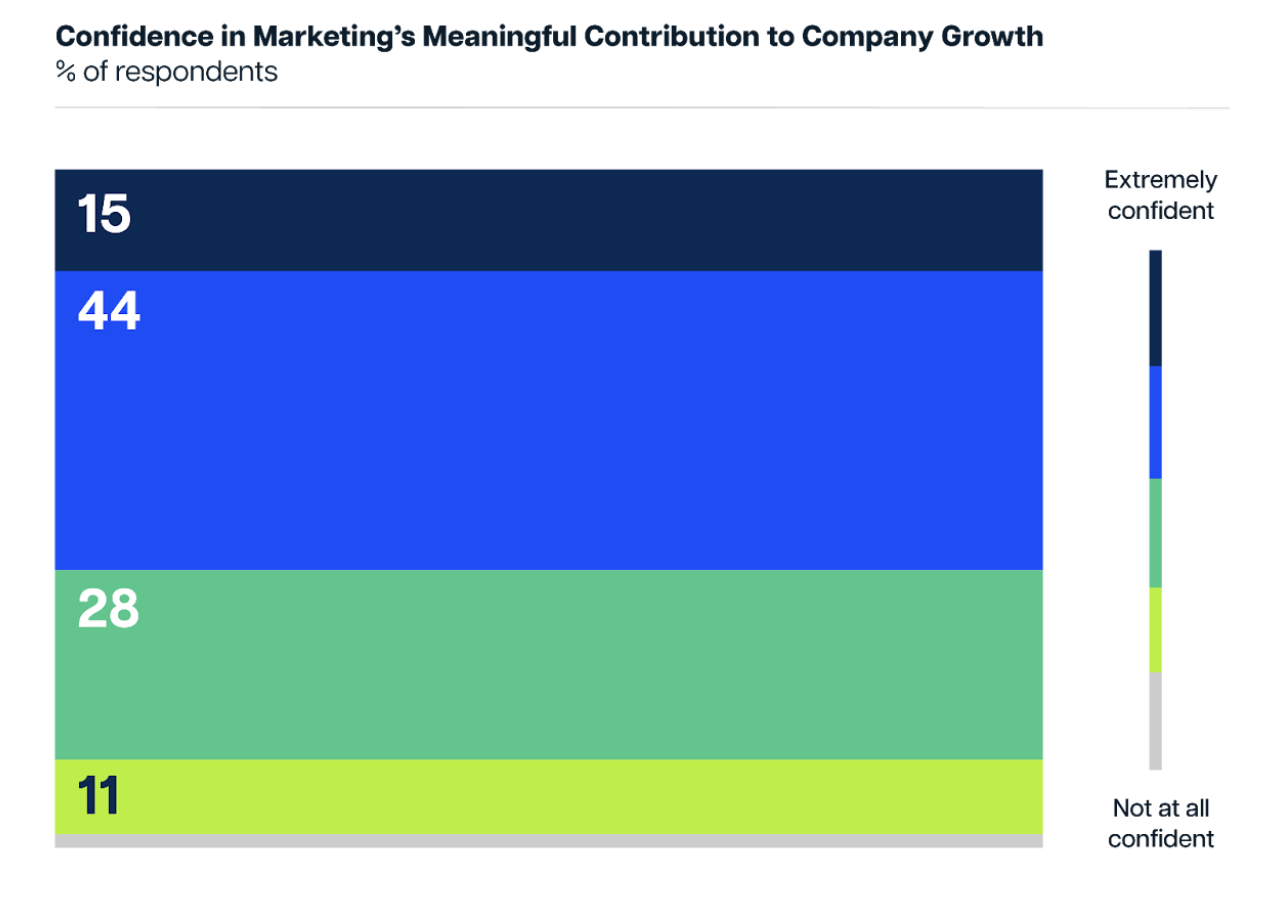
That shift suggests CEOs still believe marketing has a role to play in shaping how businesses compete, differentiate and grow. However, the strength of that belief is more muted than in previous years. While 59% of CEOs said they are confident in marketing’s contribution to growth, only 15% said they are extremely confident.
Marketing’s perceived relevance is also softening. Although the function is still viewed as relevant, the share of CEOs who said marketing is ‘much more relevant’ fell from 33% to 21%. Boathouse said this points to declining intensity of belief rather than a wholesale loss of importance.
Perhaps the most striking change is in how CEOs view marketing financially. Perceptions have flipped from marketing as a profit center to marketing as a cost center, rising from 35% to 60%. At the same time, only 35% of CEOs rated their marketing capability as best-in-class, continuing a two-year drift toward ‘average’ assessments.
“The silos have gotten stronger and stronger and calcified. But that ability to turn any of those individual performance variables into company growth is the gap, right? Everybody’s a specialist now, everyone’s just focused on their part,” concluded Connors.
“I’m trying to get CMOs to pull back and look at all of the four Ps, depending on how they define it, and take control. Even though, role-wise, they’ve been put in a narrow box, structurally they need to pull the lens back a little bit and look at the overall growth drivers of the business and then figure out how to impact those.”
More Insights